
Mobilität | Mobility
Anwesenheit und Gebürtigkeit in Österreich-Ungarn 1900 | Residence and birth place in Austria-Hungary, 1900
Mobilität
Anwesenheit und Gebürtigkeit in Österreich-Ungarn 1900
Mobility
Residence and birth place in Austria-Hungary, 1900


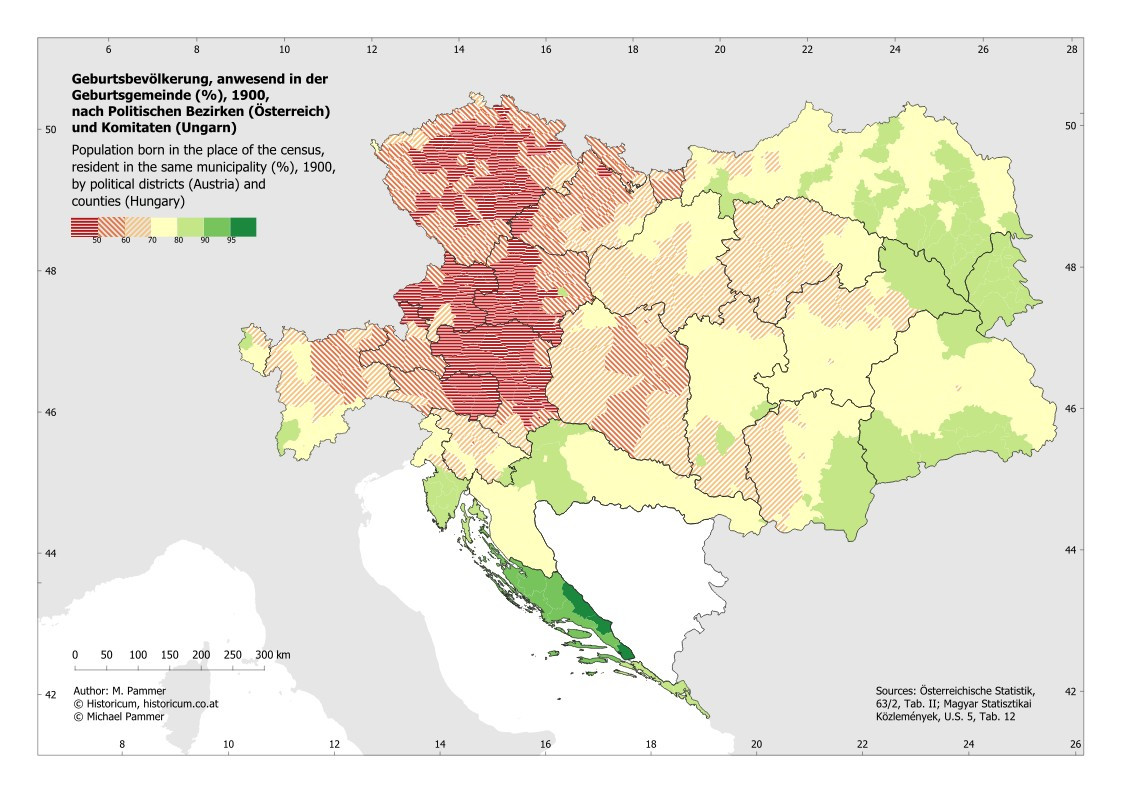


Die Volkszählungen zählten die anwesende Bevölkerung und erhoben dabei auch den Ort der Geburt. Mit Hilfe dieser Daten kann man unterscheiden zwischen
- den Geburtsorten der im Zählort anwesenden Bevölkerung und
- den Aufenthaltsorten der am Zählort geborenen Bevölkung (Geburtsbevölkerung).
Es war daher auch möglich, jene Personen zu erfassen, die im Ausland geboren und in Österreich-Ungarn anwesend waren. Personen, die in Österreich-Ungarn geboren, aber ausgewandert waren, konnte man hingegen nicht erfassen, weil überhaupt nicht in die Zählung gelangten. Die Karten unterscheiden zwischen Personen je nach dem Grad ihrer Mobilität:
- Es gab Personen, die ihren Geburtsort nicht verließen, das heißt der Ort der Anwesenheit (Zählort bei der Volkszählung) war der Geburtsort.
- Weites gab es Personen, die über kurze Distanzen wanderten. Der Indikator dafür ist die Anwesenheit im eigenen Geburtsbezirk (einschließlich der Geburtsgemeinde).
- Eine etwas weitere Wanderung ging über Bezirksgrenzen hinaus. In den Karten ist der Indikator dafür die Anwesenheit im eigenen Geburtsland (einschließlich des Geburtsbezirks).
-
Als Rest bleiben jene, die über die Grenzen des Landes gewandert waren, also sich nicht im Geburtsland aufhielten.
Die beiden Perspektiven — Herkunft der Anwesenden und Verbleib der am Ort Geborenen — führen zu meist ähnlichen, aber nicht gleichen Ergebnissen. Man kann folgende Typen unterscheiden:
- Es gab Gebiete, in denen die Bevölkerung ganz immobil war. Fast alle, die dort lebten, waren auch dort geboren, und fast alle, die dort geboren waren, lebten auch noch dort. Ein Beispiel dafür ist der Großteil von Dalmatien.
- Andere Gebiete waren Abwanderungsgebiete. Diejenigen, die noch dort lebten, waren überwiegend auch dort geboren. Aber nicht wenige, die dort geboren waren, lebten mittlerweile anderswo. Ein Beispiel dafür ist Südböhmen.
- Ein dritter Typus sind die Zuwanderungsgebiete. Von denen, die dort lebten, waren viele anderswo geboren. Aber diejenigen, die dort geboren waren, hielten sich zum beträchtlichen Teil immer noch dort auf. Ein Beispiel dafür ist Wien.
- Schließlich gab es Gebiet mit gewisser Fluktuation in beide Richtungen. In diesen Gebieten lebten Menschen, die anderswo geboren waren, und Menschen, die dort geboren waren, lebten zum Teil anderswo. Ein Beispiel dafür sind größere Teile von Oberösterreich.
The censuses counted the resident population and also recorded their place of birth. Using this data, it is possible to distinguish between
- the places of birth of the population present at the census location and
- the places of residence of the population born at the census location (the native-born population)
It was therefore also possible to record those individuals who were born abroad and present in Austria-Hungary. However, it was not possible to record individuals who were born in Austria-Hungary but had emigrated, as they were not included in the census at all. The maps distinguish between individuals according to their degree of mobility:
- There were individuals who did not leave their place of birth; that is, the place of presence (census location) was the place of birth.
- Furthermore, there were individuals who migrated over short distances. The indicator for this is presence within one’s own district of birth (including the municipality of birth).
- A slightly longer migration involved moving beyond district boundaries. In the maps, the indicator for this is presence within one’s own country of birth (including the district of birth).
- The remainder consists of those who had migrated beyond the country’s borders, i.e. who were not present in their country of birth.
These two perspectives — the origins of those present and the whereabouts of those born locally — generally yield similar, though not identical, results. The following categories can be distinguished:
-
There were areas where the population was entirely immobile. Almost everyone living there had also been born there, and almost everyone born there still lived there. A prime example of this is the majority of Dalmatia.
-
Other areas were areas of emigration. Those who still lived there were predominantly born there too. But quite a few who were born there now lived elsewhere. An example of this is South Bohemia.
-
A third type consists of areas of immigration. Of those living there, many were born elsewhere. But a considerable proportion of those born there still resided there. An example of this is Vienna.
-
Ultimately, there were areas characterised by a certain degree of population movement in both directions. These areas were home to people who had been born elsewhere, whilst some of those born there had moved away. An example of this is much of Upper Austria.
Sie dürfen bis auf Widerruf die Inhalte dieser Seite zu nichtkommerziellen Zwecken kostenlos kopieren, weitergeben und vorführen, sofern Sie Autor und Inhaber des Copyright angeben. Eine kommerzielle Nutzung ist nicht gestattet.
The owner hereby grants a revocable, royalty-free license to reproduce, distribute, and display the content of this page for non-commercial purposes. You must include a notice on the author and the copyright holders. A commercial use is not permitted.
